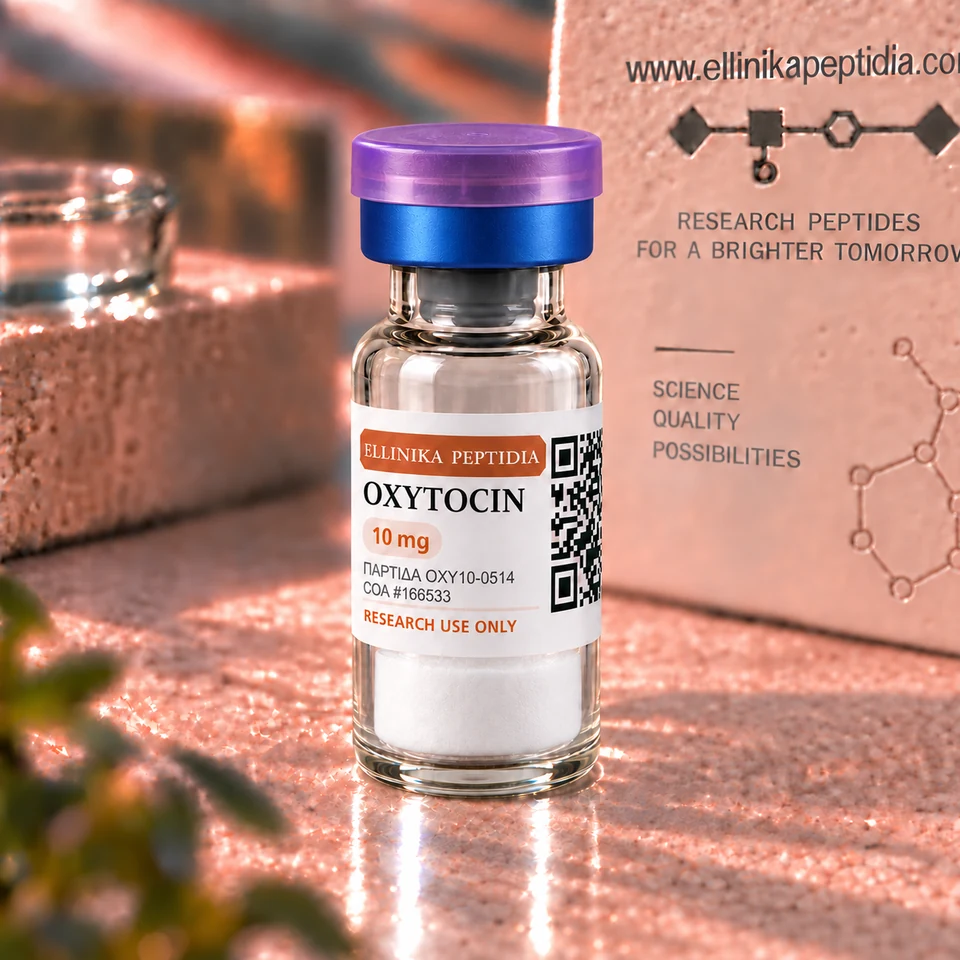
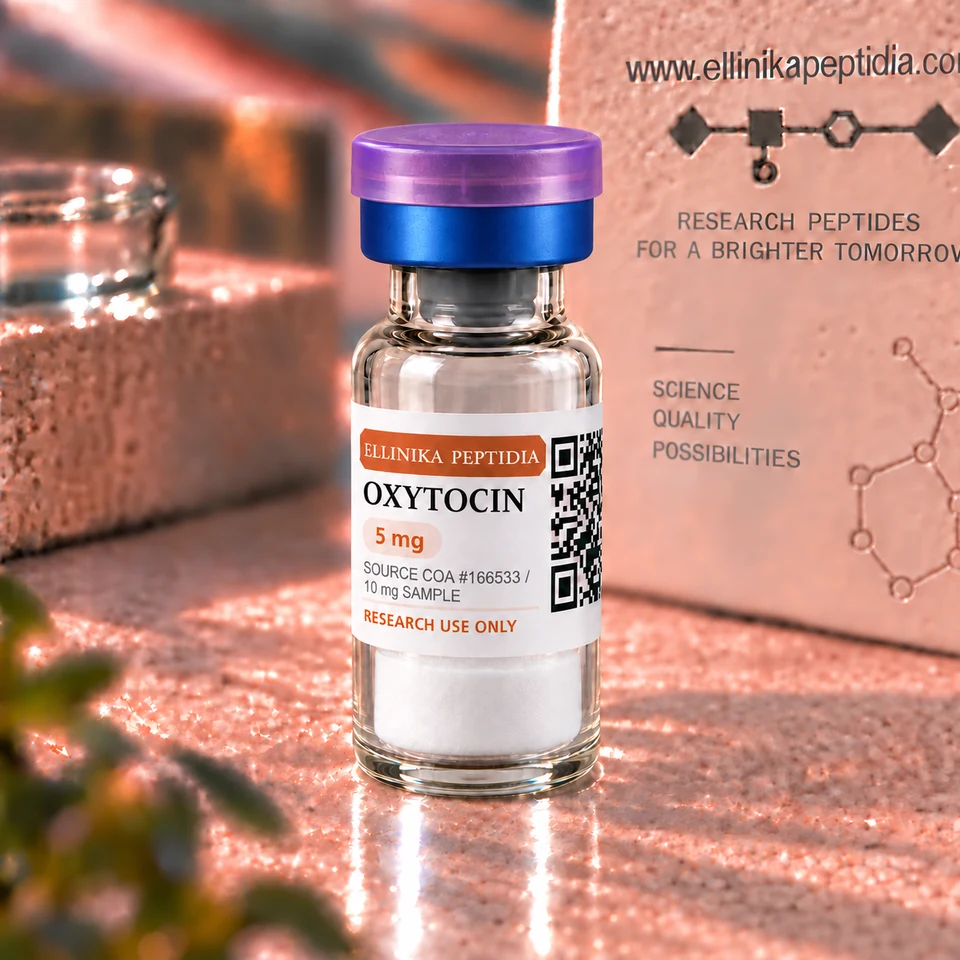
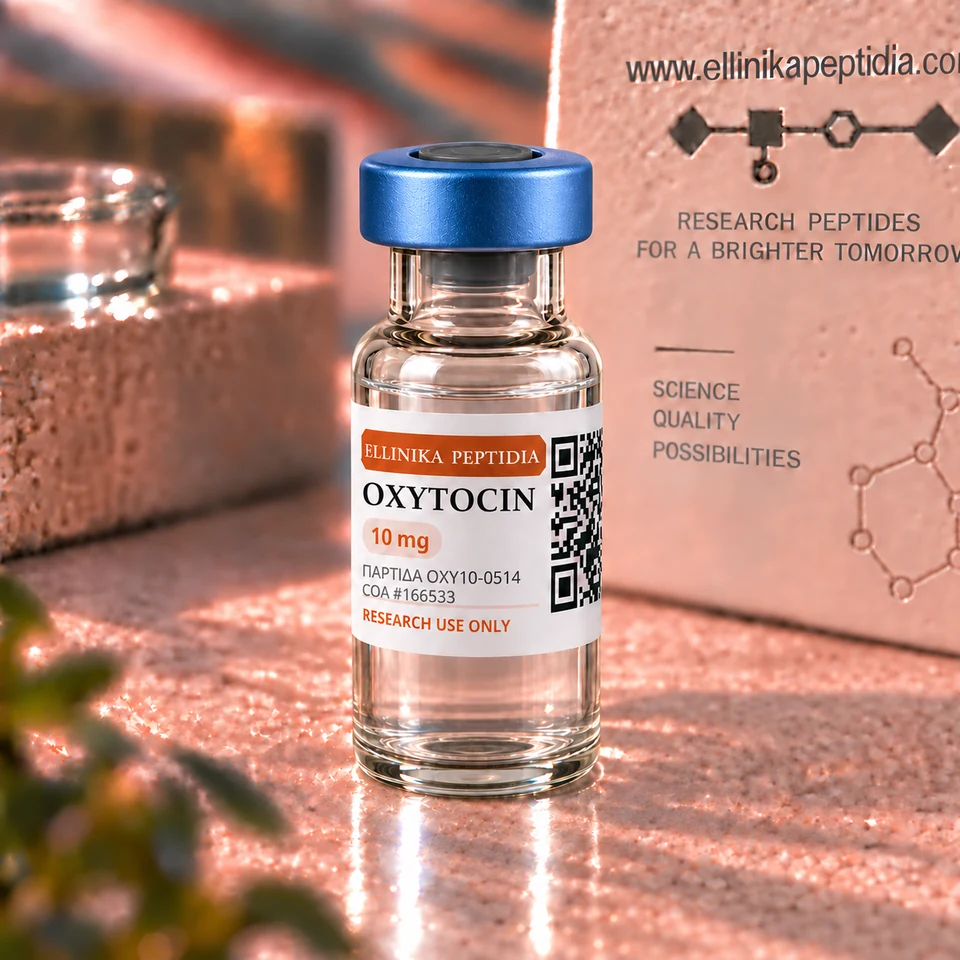
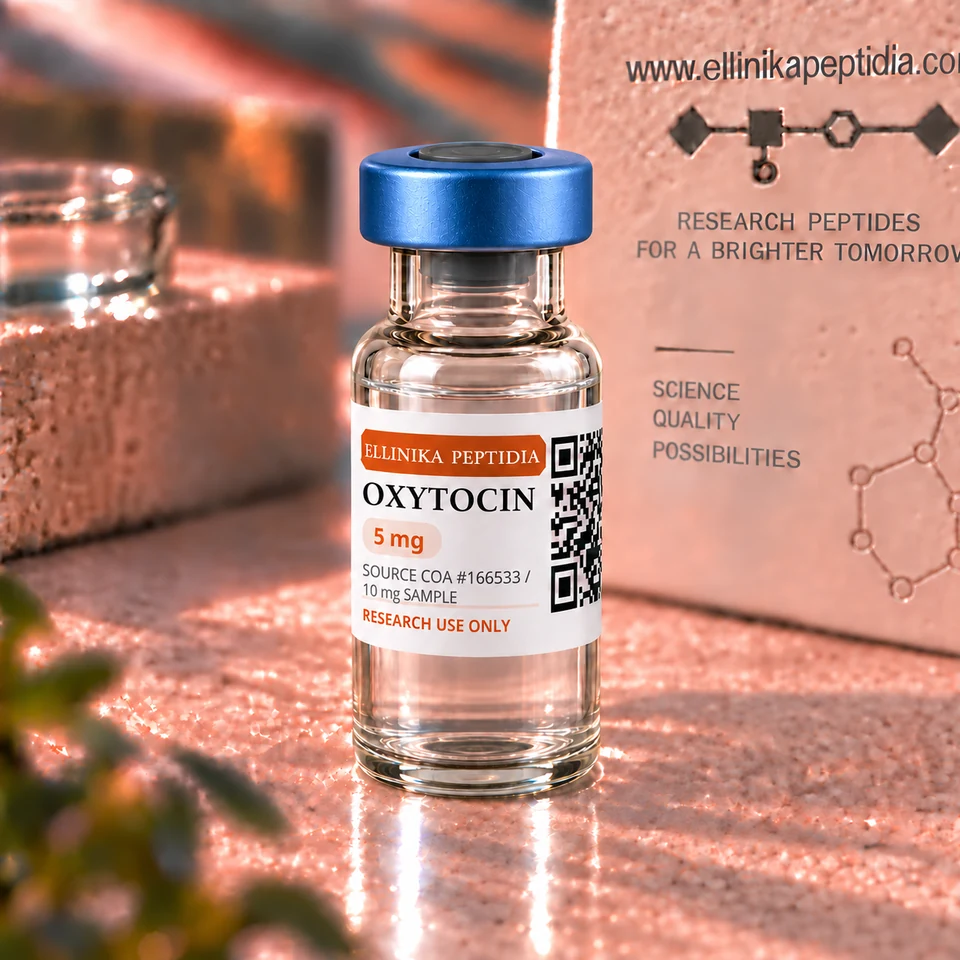
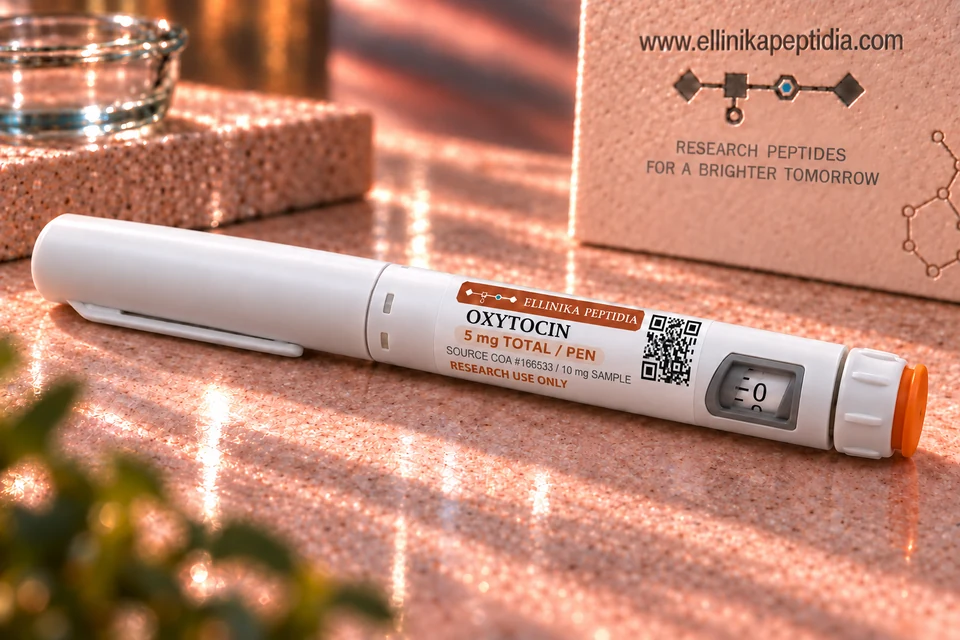
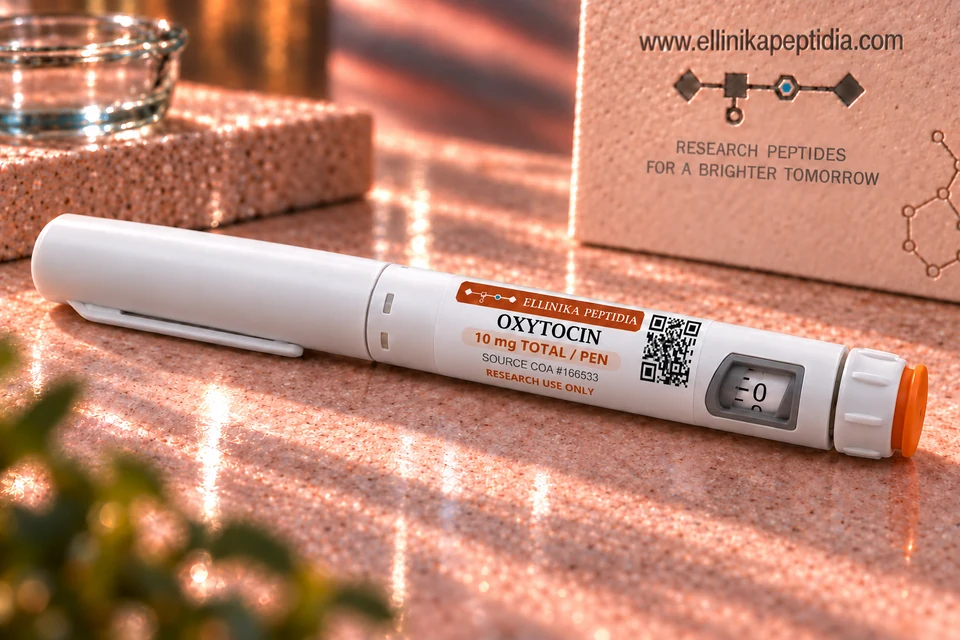
Minimum order 2 vials or 2 pens — delivery in 2 weeks The “love hormone.” A meta-analysis of 17 randomized trials with 466 participants found an effect size of 0.08 on emotion recognition. In other words, nothing.
Illustrations of the product — not photos of a specific batch.
A real hormone with a real job: childbirth, breastfeeding, bonding. That's where the nickname “love hormone” came from, and that's what kicked off two decades of studies with intranasal dosing.
The mechanism under study involves social processing in the brain — emotion recognition, empathy, theory of mind.
The number: a meta-analysis of 17 randomized trials, 466 participants. Emotion recognition g = 0.08, empathy g = 0.49 not significant, theory of mind g = 0.21 small but significant 1.
The honest part, in the authors' own words: “the promise of intranasal oxytocin should be viewed with caution” 1. Separately, a functional MRI study found a measurable change in amygdala connectivity — mainly in older adults 2.
So something happens in the brain and it's measurable; whether it translates into a change in behavior is a different question, and the literature answers with numbers close to zero.
A notoriously unstable hormone — its clinical form ships cold-chain. Fridge, dark, use soon after reconstitution.
Sources — 2 published studies
Keech B, Crowe S, Hocking DR. Intranasal oxytocin, social cognition and neurodevelopmental disorders: A meta-analysis. Psychoneuroendocrinology. 2017;87:9-19. doi:10.1016/j.psyneuen.2017.09.022
Liu P, Lin T, Feifel D, Ebner NC. Intranasal oxytocin modulates the salience network in aging. Neuroimage. 2022;253:119045. doi:10.1016/j.neuroimage.2022.119045
The “love hormone”? Let's look at the numbers first, not the nickname.
It's given intranasally and has been studied for two decades for social behavior — emotion recognition, empathy, bonding.
Straight talk: a meta-analysis of 17 studies, 466 people. Emotion recognition g = 0.08 — essentially nothing. Empathy not statistically significant. Only theory of mind came out small but significant, g = 0.21 1. The authors themselves say to view it “with caution” 1.
But there is something, and it's measured: in an 85-person resting-state MRI study, oxytocin changed amygdala connectivity within the salience network — but the finding showed up only in the older participants 2.
We won't sell you a “love hormone.” We'll tell you what the numbers show: a measurable change in the brain, a change in behavior close to zero.
Unstable in heat — the heat in a car is enough to ruin it. Fridge, dark, use soon after reconstitution.
Sources — 2 published studies
Keech B, Crowe S, Hocking DR. Intranasal oxytocin, social cognition and neurodevelopmental disorders: A meta-analysis. Psychoneuroendocrinology. 2017;87:9-19. doi:10.1016/j.psyneuen.2017.09.022
Liu P, Lin T, Feifel D, Ebner NC. Intranasal oxytocin modulates the salience network in aging. Neuroimage. 2022;253:119045. doi:10.1016/j.neuroimage.2022.119045
The substance with the widest gap between its reputation and its numbers.
Oxytocin is a real hormone with a real job: childbirth, breastfeeding, bonding. That's where the nickname “love hormone” came from, and that's what kicked off two decades of studies giving it intranasally to see whether it changes social behavior.
Let's look at what they found, all in one place. A meta-analysis of 17 randomized controlled trials, 466 participants with neurodevelopmental disorders. Emotion recognition: g = 0.08 — in other words, nothing. Empathy: g = 0.49, not statistically significant. Theory of mind: g = 0.21, small but significant. And neither dose nor dosing frequency changed the outcome1.
The conclusion is the authors' own, not ours: “the promise of intranasal oxytocin should be viewed with caution”1.
What does actually happen.85 people — 42 younger, 43 older — randomized to intranasal oxytocin or placebo before a resting-state MRI. The oxytocin group had lower connectivity of the left amygdala and right insula within the salience network — the network that decides what deserves your attention. And the amygdala finding showed up only in the older group2.
How we read it. Something happens in the brain, and it's measurable. Whether that changes what you feel or what you do, the meta-analysis answers with numbers close to zero. That's a long way from “love hormone,” and we won't sell it to you that way.
Sources — 2 published studies
Keech B, Crowe S, Hocking DR. Intranasal oxytocin, social cognition and neurodevelopmental disorders: A meta-analysis. Psychoneuroendocrinology. 2017;87:9-19. doi:10.1016/j.psyneuen.2017.09.022
Liu P, Lin T, Feifel D, Ebner NC. Intranasal oxytocin modulates the salience network in aging. Neuroimage. 2022;253:119045. doi:10.1016/j.neuroimage.2022.119045
Both studies involve intranasal administration. 1 specifically covers people with neurodevelopmental disorders — it doesn't carry over as-is to healthy people.
We don't keep it in stock — it's ordered in: minimum 2 items (vials or pens) from the special-order products, with free shipping, and it arrives in about 2 weeks.
How much is shipping?
€3 shipping + €3 cash-on-delivery fee. For orders of 2 vials or pens or more, shipping and the cash-on-delivery fee are free. Delivery time depends on the courier.
How do I pay?
Cash on delivery, paid to the courier when it arrives. For an electronic money transfer (PayPal, Revolut, Wise, crypto), email us for the details: ellinikapeptidia@gmail.com
Can I return it?
Yes: you have a 14-day right of withdrawal from delivery, as long as the seal is intact. Return costs are yours, unless the product was faulty or wrong. Terms of Use
Want something you don't see here? Write to us — we reply.
Related products
From the same category
%OFF
DSIP
DSIP
from €29.60 to €58.40
Minimum order 2 vials or 2 pens — delivery in 2 weeks
Delta sleep-inducing peptide. The name promises sleep. A 2006 review calls it an “unresolved riddle” — the gene, the protein and the receptor were never found.
Minimum order 2 vials or 2 pens — delivery in 2 weeks
Spadin analog and TREK-1 channel inhibitor: it inhibited TREK-1 with an IC50 of 0.12 nM (vs 40–60 nM for spadin) and reduced immobility in the forced swim test.